




Trucks VS. SUVS
GMC Trucks and SUVs: How to Determine Which Meets your Needs
Let’s say you have a camper and are looking for a new vehicle to tow it. And you’re wondering whether you need a truck or an SUV to do the job.
Short answer: Depends on the size of the camper.
Or maybe you’re more interested in a comfortable, roomy interior and a vehicle that’s easy to parallel park.
Buick/GMC offers trucks and SUVs capable of accommodating a wide range of vehicle needs, all of which have their particular advantages. Choosing the right one means determining whether the vehicle’s strong points coordinate with your needs and driving style.
To put it another way: knowing what you want your new vehicle to do for you can help you streamline the decision-making process. When you’ve narrowed things down, you’ll be ready to schedule a test drive at your Mullinax Buick/GMC dealership and talk details – and hopefully, a deal – with one of our sales professionals.
So how do you make sense of all the options? By looking at functionalities and characteristics, so we might as well might start by considering that camper.
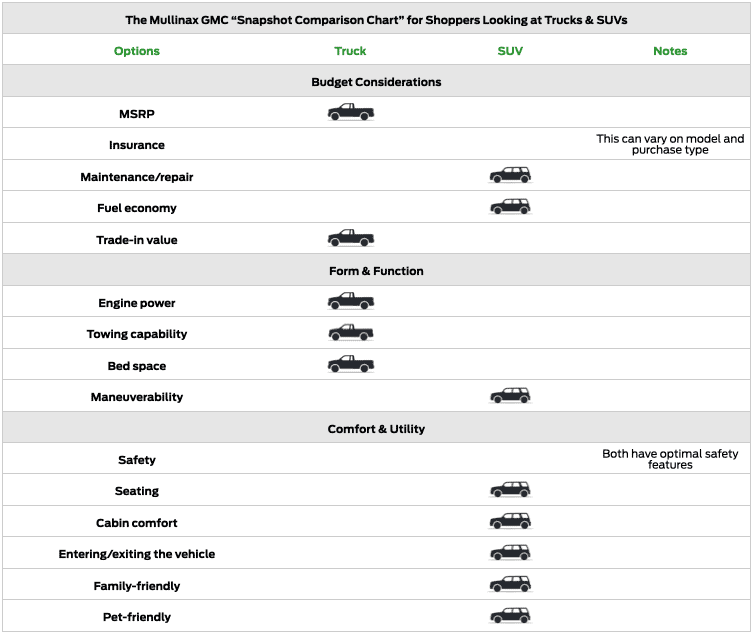
Towing capacity: Most mid-sized and even small SUVs can handle a camper of some sort. If you’re pulling a fifth-wheel you’re going to need something bigger. A whole lot bigger.
Compact SUVs such as the GMC Terrain or Buick Encore can trailer about 1,000 pounds, which works out to a teardrop camper or a small trailer carrying a couple of canoes or snowmobiles, or a small boat trailer and a basic fishing boat.
The mid-size Buick Enclave with a V6 engine and the available trailering package gets you 5,000 pounds of towing capacity while a full-size GMC Yukon can pull close to 8,000 pounds.
But if you want to run with the big dogs, step up to a truck. With a Sierra 1500 or a Sierra HD, you’re looking at 36,000 pounds of towing power.
To see how much your prospective vehicle can handle, look at the gross vehicle weight rating on the sticker inside the driver’s side door. The number tells you the maximum weight the vehicle should tow.
Bottom line: if you do a lot of towing, or tow substantial loads, your best choice is probably a truck.
Hauling ability: Trucks generally dominate this category too. Truck beds are designed specifically for hauling things, including power tools, work gear, farm necessities, big-screen TVs and the couch you agreed to help your buddy from college move to his new place. They’re also configured to make loading and unloading items easy – in other words, you could probably fit that new TV in the cargo space of an SUV, but you’ll have a less problematic time getting it into and out of a truck bed. Finally, bed liners and covers help protect the hauling space from the elements.
Engine power: Again, trucks are out front here. Because they’re generally larger and built sturdier than SUVs, they have more oomph under the hood. In fact, truck engines, especially those in the heavy-duty versions, are about as powerful as you can get in a consumer vehicle, especially if you choose the diesel upgrade.
Creature comfort: Some trucks, especially the high-end versions, offer a high level of refinement. The Sierra Heavy Duty, for instance, comes in a crew cab with room for six, plus power-adjustable seats, a sunroof and high-tech safety and infotainment features.
Still, it’s a pretty rugged truck and trucks overall tend to have less cabin space and a rougher ride, especially for passengers.
If a comfortable interior is one of your top criteria, you will likely be better served by an SUV.
SUVs, even the affordable ones, rate higher for roominess, amenities and other factors that make the driving/riding experience more pleasurable. The ride is smoother, the cabin larger and intuitively laid out, the seats easy to sit in for long trips. Plus, there’s space for everybody, including kiddie car seats – which don’t always fit well in the smaller back seat of a truck – and the family pets. And if Fido is a large breed, he’ll appreciate the extra head room as much as your tall passengers do.
SUVs also have lower ground clearance than trucks, making them easier to get into and out of.
Asphalt vs. off-road: SUVs excel in both of these conditions. Though trucks have a reputation for being tough, they’re mainly intended to be used on roads or in wide-open spaces.
SUVs do better both in the tight confines of city traffic and out where the roads don’t run. Their generally smaller size makes them easier to drive and park than their truck cousins, while a locking four-wheel-drive system provides the off-road traction to keep you om track toward the trailhead.
Safety: Trucks have an edge here. Their larger size tends to make them safer than many other vehicles on the road. Before deciding, check the Insurance Institute for Highway Safety (IIHS) safety ratings, paying particular attention to front-crash prevention systems and automatic emergency braking equipment, which can help you avoid accidents.
Finally, you have some financial issues to consider, including:
Initial costs: For many manufacturers, trucks sport lower MSRPs than SUVs. In the Buick and GMC lineups, the SUVs can actually save you some coin. The GMC Terrain starts at $29,990 while the Canyon, GMC’s entry-level truck, starts at $36,900. Buick SUVs can save you even more: the new 2024 Envista (in the base, ST and Avenir trims) carries a base price of $22,400.
Maintenance and repair costs: The type of vehicle you choose and the way you use it can cause maintenance and repair numbers to vary widely. While an SUV that’s frequently used off-road may need more frequent maintenance, on average, trucks are pricier to keep on the road.
Insurance: You have lots of moving parts here, no pun intended. Size, usage, vehicle construction – a whole range of risks factors comes into play. Trucks tend to have the edge when it comes to insurance coverage though, in part because SUVs have a higher center of gravity and a greater tip-over risk. We advise consulting your insurance agent before making a purchase.
Fuel efficiency: Trucks tend to be larger and heavier than SUVs, which means they burn more fuel than most SUVs. And the more capabilities they offer — greater towing and hauling capacities, for instance – the more gas or diesel they drink as well. So SUVs have the advantage here, but check the mpg ratings of the vehicles you are considering before choosing a vehicle.
Trade or resale value: Trucks win this category. High demand and a reputation for durability and longevity mean trucks retain 58.8 percent of their value after five years, compared to just over 50 percent for SUVs – and both outdo cars.
Are you closer to a decision yet? If so, we’d love to have you come by for a test drive. If not, we at Mullinax Buick/GMC are here to answer your truck and SUV questions and help you make the choice that’s right for you.
0 comment(s) so far on Trucks VS. SUVS